Rolls-Royce Heritage Trust
Historical Series Reviews - Page 05
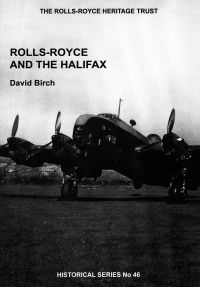 |
Rolls-Royce and the Halifax
by David Birch
Softbound, 210mm x 148mm x 10mm, 140 pages
ISBN: 978-1-872922-36-2
Rolls-Royce Heritage Trust
P.O. Box 31
Derby DE24 8BJ
England
Recommended Retail Price:
Please see Book List/Order Form
28 photos/illustrations
|
Reviewed by Kimble D. McCutcheon, 30 October 2013
Like many RAF bombers, two different engines were used to power the Handley Page Halifax; early models used Rolls-Royce Merlins, while later ones used the Bristol Hercules. Although the Hercules powered variants performed fairly well, the early Merlin powered aircraft were beset with a host of problems. Both the Avro Lancaster and Halifax evolved from a twin-engine design. When development problems appeared with the Rolls-Royce Vulture, which was to have been used in the twin, the Air Ministry ordered a Halifax redesign using four Merlins. When the mock-up was examined, 100 aircraft were ordered off the drawing board.
Then, specification creep began. Bomb load was increased, exhaust flame dampers installed, guns and other fighting appurtenances added. Empty weight increased, drag increased, and performance suffered, resulting in an airplane that was so slow at cruise (10 ~ 15 mph above stall) that maneuvering was dangerous, and one that had to jettison its bomb load if an engine failed during takeoff or early in the mission. These circumstances conspired to cause crews to mercilessly flog the engines.
Rolls-Royce had designed and produced the complete firewall-forward power plant package for the Armstrong Whitworth Whitley and Vickers Wellington, and had worked closely with Avro on the Lancaster power plant. However, Handley Page decided to keep engine installation responsibility. R-R only became involved after problems with excessive cooling drag, leaking radiators, vibration and ineffective flame dampers appeared.
A drastic drag reduction program, in conjunction with the introduction of Merlins with two-stage superchargers, finally produced a reasonable airplane. But the damage was done, both to Merlin-powered Halifaxes, and to the type in general, as squadrons clamored to exchange their Halifaxes for Lancasters.
As with all of Mr. Birch's previous books, this one includes detailed appendices of aircraft serviceability reports, meeting minutes, a forced landing report, engine handling notes, and a list of the Halifaxes tested at the Rolls-Royce flight test facility at Hucknall.
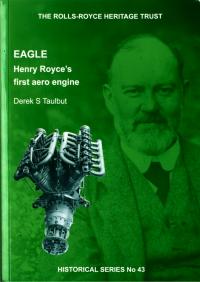 |
Eagle
Henry Royce's First Aero Engine
by Derek S. Taulbut
Softbound, 208mm x 148mm x 21mm, 348 pages
ISBN: 978-1-872922-40-9
Rolls-Royce Heritage Trust
P.O. Box 31
Derby DE24 8BJ
England
Recommended Retail Price:
Please see Book List/Order Form
90 photos/illustrations
|
Reviewed by Kimble D. McCutcheon
On 4 August 1914 Great Britain declared war on Germany. On 17 December 1915 Rolls-Royce's first two Eagle aero engines flew. By 31 December 1918 Rolls-Royce had produced 3,123 Eagles and at least 1,839 of its two derivatives, the Falcon and Hawk. Rolls-Royce had no serious interest in aero engines prior to British involvement in WWI; by the end of the war, Rolls-Royce had delivered more than 1.5M horsepower and equipped 5/8 of all British aircraft.
Frederick Henry Royce, in poor health and working from his winter home on the French Provencal coast, directed the Rolls-Royce aero engine effort through an experienced and capable staff. A series of letters and drawings emerged from the hand of Royce. His letters were recorded by Rolls-Royce Directors in the secretive "Blue Book".
Derek Taulbut has produced an exceptional account of those four years. Working from the "Blue Book", drawing registries, and surviving drawings, along with numerous other secondary sources, Taulbut leads the reader on a journey that explores Royce's personality and approach to design. From this foundation, Taulbut details the Eagle from concept, through WWI, and to the first non-stop trans-Atlantic flight of Alcock and Brown in an Eagle-powered Vickers Vimy IV.
Taulbut's description shows great insight into the engine development process and is filled with technical details along with accounts of design, production and political challenges. An appendix of 38 extensive notes occupies nearly 1/3 of the book and amplifies narrative details.
Eagle is impressive in its detail and meticulously researched. Taulbut loves old steam engines and is an authority on the Rolls-Royce R engine. Also an authority on Grand Prix cars and motorcycles, he has written a history of Grand Prix cars and racing, which is the basis of a web site http://www.grandprixengines.co.uk/
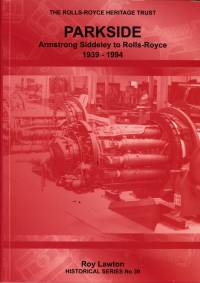 |
PARKSIDE
Armstrong Siddeley to Rolls-Royce
1939 - 1994
by Roy Lawton
Softbound, 208mm x 148mm x 13mm, 249 pages
ISBN: 978-1-872922-35-5
Rolls-Royce Heritage Trust
P.O. Box 31
Derby DE24 8BJ
England
Recommended Retail Price:
Please see Book List/Order Form
181 photos/illustrations
|
Reviewed by Doug Culy
Parkside (R-RHT Historical Series No 39) is the story of Armstrong Siddeley’s (AS) rise as a producer of gas turbine engines—and the story of its slow decline. Overall, the Parkside plant provided engines and cars (for a while) from 1896 to 1994, longer than most facilities have survived the advance of production technology. The first half of this period was covered by Rolls-Royce Heritage Trust Historical Series No. 11, ARMSTRONG SIDDELEY – the Parkside story 1896 – 1939.
During WWII, Parkside produced mainly the Cheetah 834 in³ 7-cylinder radial engine, of which over 25,000 were built. Also at Parkside were production and development activities for the Tiger 1,512 in³ 14-cylinder radial (actually a renamed Jaguar), the Deerhound three-row 21-cylinder radial, and the Cougar 9-cylinder radial. These effectively ended the production of AS piston aircraft engines. Also in production during WWII were the AS line of cars contemporary to Jaguar and Rolls-Royce (R-R), and torpedo motors. The book devotes a dozen or so pages to bomb damage (Parkside was located in Coventry) from several German air raids. Gas turbine activities had started during the war with the building of a scale demonstrator for A.A.Griffith’s first axial-flow engine, as a turbocharger, and with a steam turbine aero engine. Late in 1942, AS began development of the ASX reverse-flow axial turbojet engine, which started test in 1943.
After WWII Parkside was used for further production of cars until 1960 (amazingly including the Sunbeam Alpine sports car) and to build 1-, 2-, and 3-cylinder diesel generator sets. The ASX was revised to turboprop configuration and was developed as the Python. Their next engine was the Mamba turboprop, produced in single and twin configurations, the jet version of which was the Adder. AS took over the development of the 7,500-lb-t Sapphire axial turbojet from Metropolitan Vickers, and this later became the USAF J65. A small turboshaft/prop engine, the 1,100-shp P181/P182 was demonstrated but not produced. The Sapphire provided the background for the 1000-lb-t Viper, which was initiated as a short-life missile engine. It was shortly seen to have much merit for manned-aircraft and continued development to 4,400 lb-t, and over 5,000 were built, including off-shore production. The Gamma rocket engine was developed, and AS absorbed the Blackburn engine line, which included licensed production of Turbomeca engines. After merger with R-R in 1961, Parkside was assigned the building of the 7760-lb-t M45H turbofan development engines from the R-R joint venture with Snecma. This was the engine for the Fokker 614 airliner, and only 60 were built. By the late 1960s, R-R transferred much Viper production to other plants, and in 1979, R-R transferred Adour production to Parkside, and the abortive R-R RB401 5400-lb-t turbofan was developed there around 1980 to compete with the Garrett TFE731. From then on, whole engine production gradually went away while Parkside was focused more on parts for various R-R engines. In 1988, parts production began to be sent to other R-R facilities, and in 1994, Parkside was sold to a real estate developer.
 |
Overhaul of Merlin Engines
in India and the USSR
by Charles W. Evans and Yuri Rybin
Softbound, 208mm x 148mm x 13mm, 203 pages
ISBN: 978-1-872922-44-7
Rolls-Royce Heritage Trust
P.O. Box 31
Derby DE24 8BJ
England
Recommended Retail Price:
Please see Book List/Order Form
57 photographs
|
Reviewed by Doug Culy
This book is actually two separate books describing the problems of operating and maintaining Merlin engines under differing kinds of severe environments during WWII.
The authors describe in detail the privations of bad fuel (Russia), spares supply shortages, and inadequately trained maintainers.
Of particular interest are the many overhaul reports and inter-office communications shown from Indian operations, and the report summarizing the Russian experience, by a R-R team sent there upon request for support (after previously refusing offers of help) by the Russian government.
Also insightful are descriptions of cultural attitudes in India about who should be doing maintenance work, and about how the Russian air service perceived foreign aircraft given to them. Operation of these aircraft under really bad conditions is well described. There is plenty of worthwhile discussion supplying background for the setting-up and conduct of maintenance operations in both regions, and a satisfying number of useful photos.