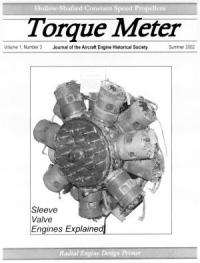
Torque Meter
Summer 2002 Issue
|
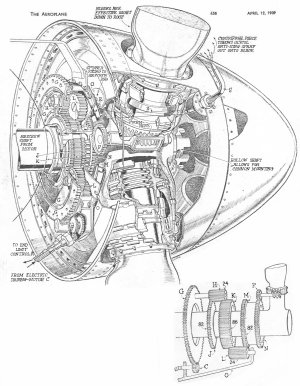 |
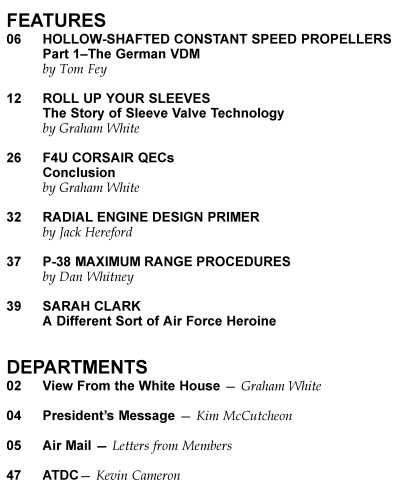
Hollow-Shafted Constant Speed Propellers As if designing a dependable constant speed propeller wasn’t sufficient challenge for engineers of the 1930s, how about building one with a hollow shaft that would accept the barrel of a cannon through the middle! This was successfully accomplished by Vereinigte Deutsche Metallwerke (VDM) in Germany. |
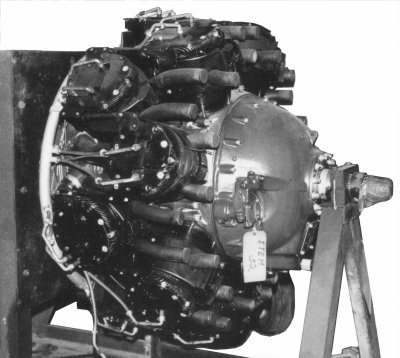 |
Sleeve Valve Engines Explained Many variations on the aircraft piston engine theme have evolved since the Wright brothers made their first powered flight. Most were relegated to the history books never to be seen or heard from again. One exception was the sleeve valve or as it is more correctly referred to, the single sleeve, Burt/McCollum engine. Today little is known or understood about this concept. This is too bad because it was demonstrably superior to comparable poppet valve engines. Far from being an historical oddity, the British RAF pinned much of its hopes on this engine technology during World War II. |
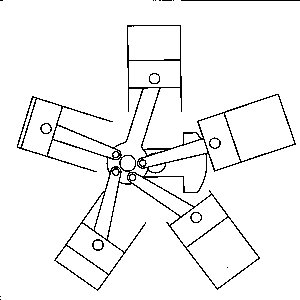 |
Radial Engine Design Primer If you’re old enough, you know that REAL airplane engines are round. Today, these noble machines are not often seen and the average engine-mad schoolboy is probably not able to describe the inner workings of a round engine. "How does a radial work?" usually comes down to two questions. How do all those cylinders manage to connect to one crankshaft, and what moves the valves? |
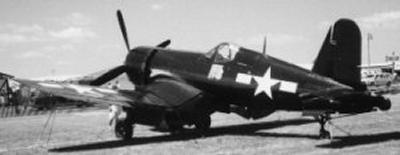 |
Corsair Engine Installations, Part 3 Delving into the engineering that went into all the F4U variants, author Graham White corresponded with Don Jordan, the man responsible for engineering all the Corsair engine installations. Any aircraft installation is an engineering challenge. In the case of the Corsair, it had to accommodate the massive eighteen-cylinder Pratt & Whitney R-2800 engine along with the necessary intercoolers, oil coolers and ducting. Part 3 concludes with specifications for all Corsair models. |
Send mail to
 with questions or comments about this web site.