|
 |
 |
|
|
|
|
|
 |
Books about aircraft engines are not confined strictly to collectors' dusty shelves. New ones are being published all the time. Many of these books, both old and new are reviewed in this section. Please note that the opinions expressed herein are those of the reviewers and do not necessarily reflect the views of the Aircraft Engine Historical Society. If you have a different impression of a book, send us a review! |
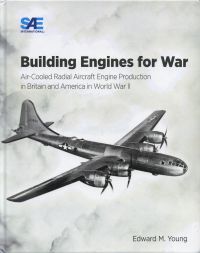 |
Building Engines for War Hardbound, 8.25" x 10.25" x 1.125", 352 pages Recommended Retail Price: US $115.00 Color Charts, black & white images |
Reviewed by Kimble D. McCutcheon; 1 Mar 2024
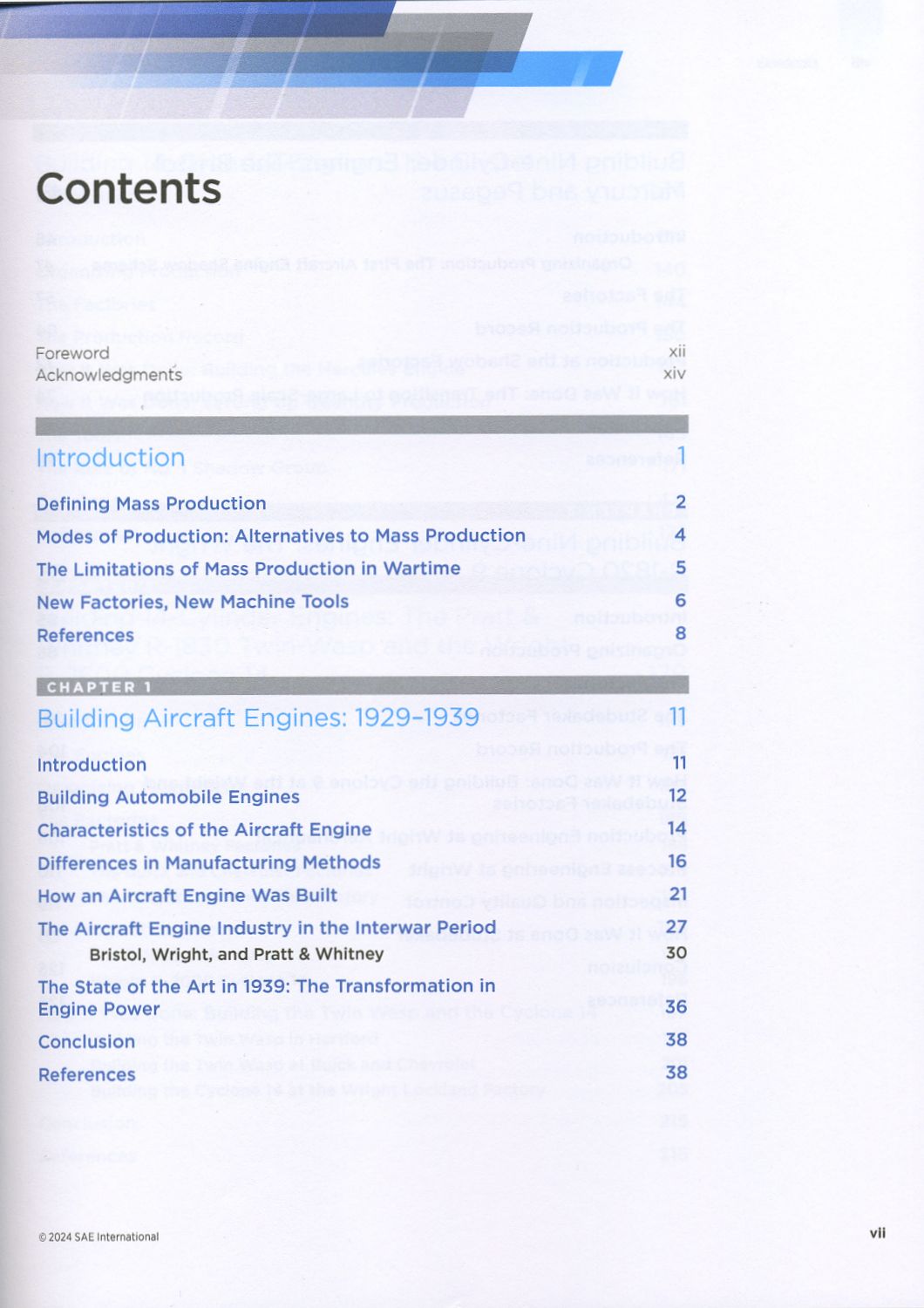
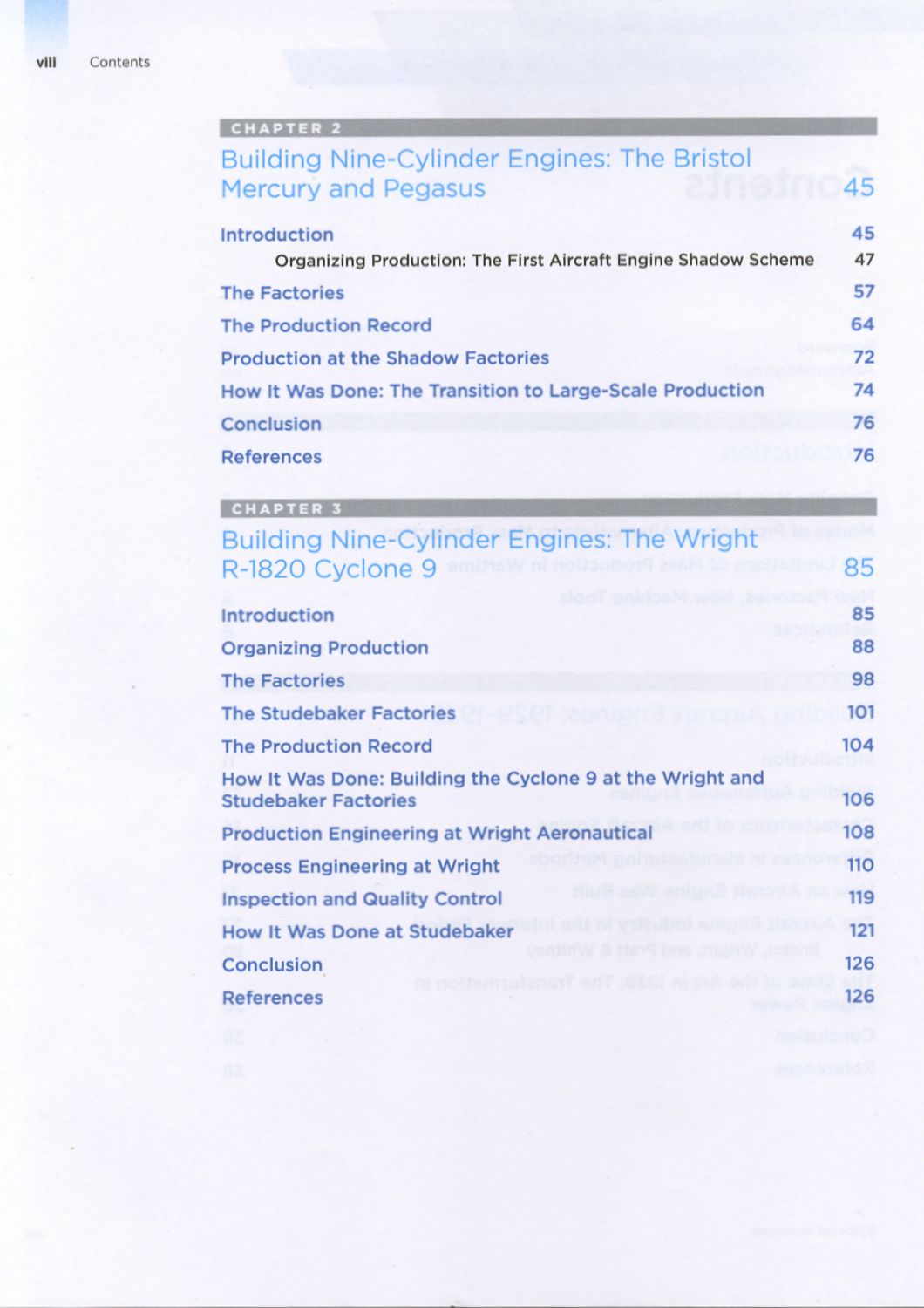
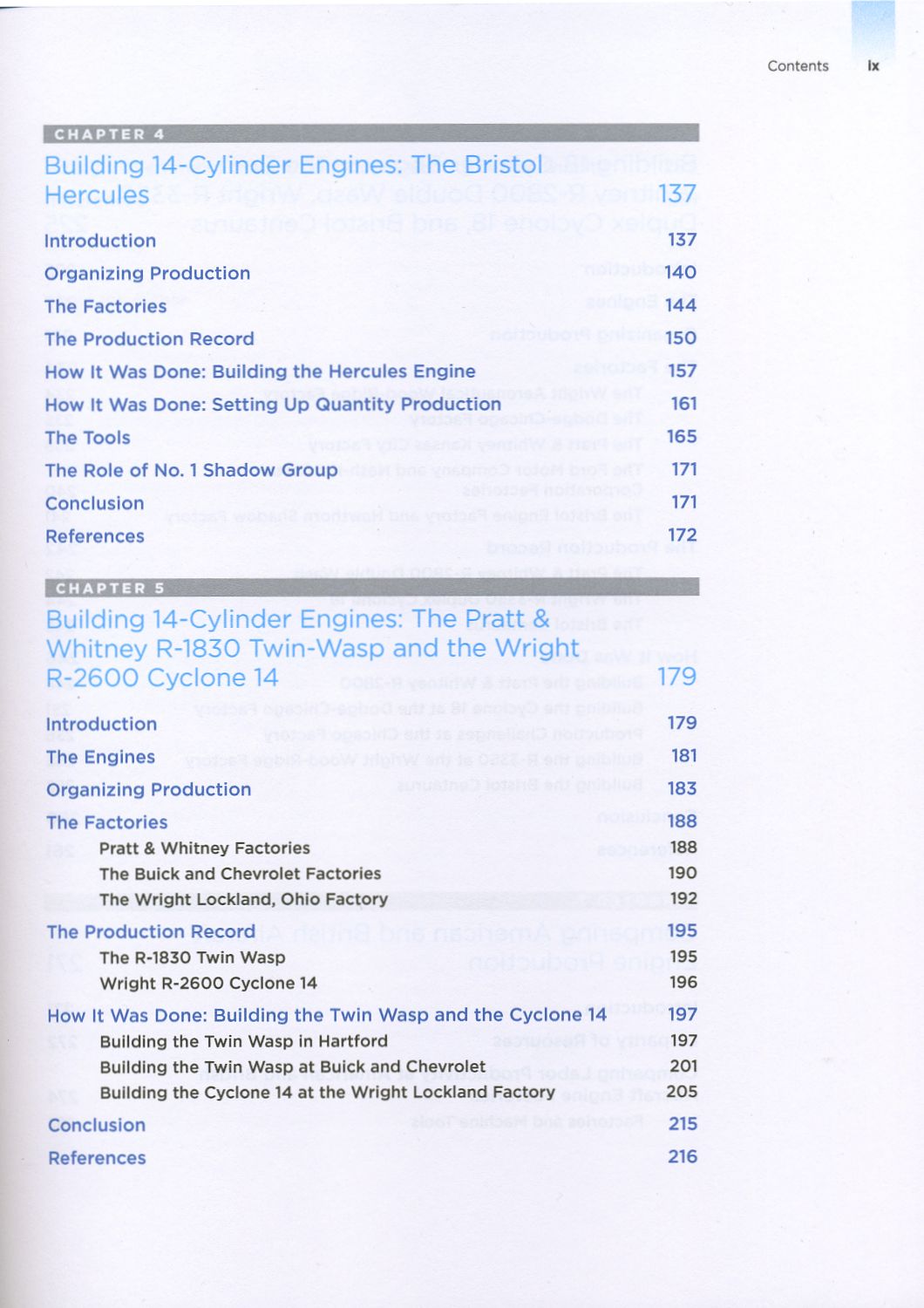
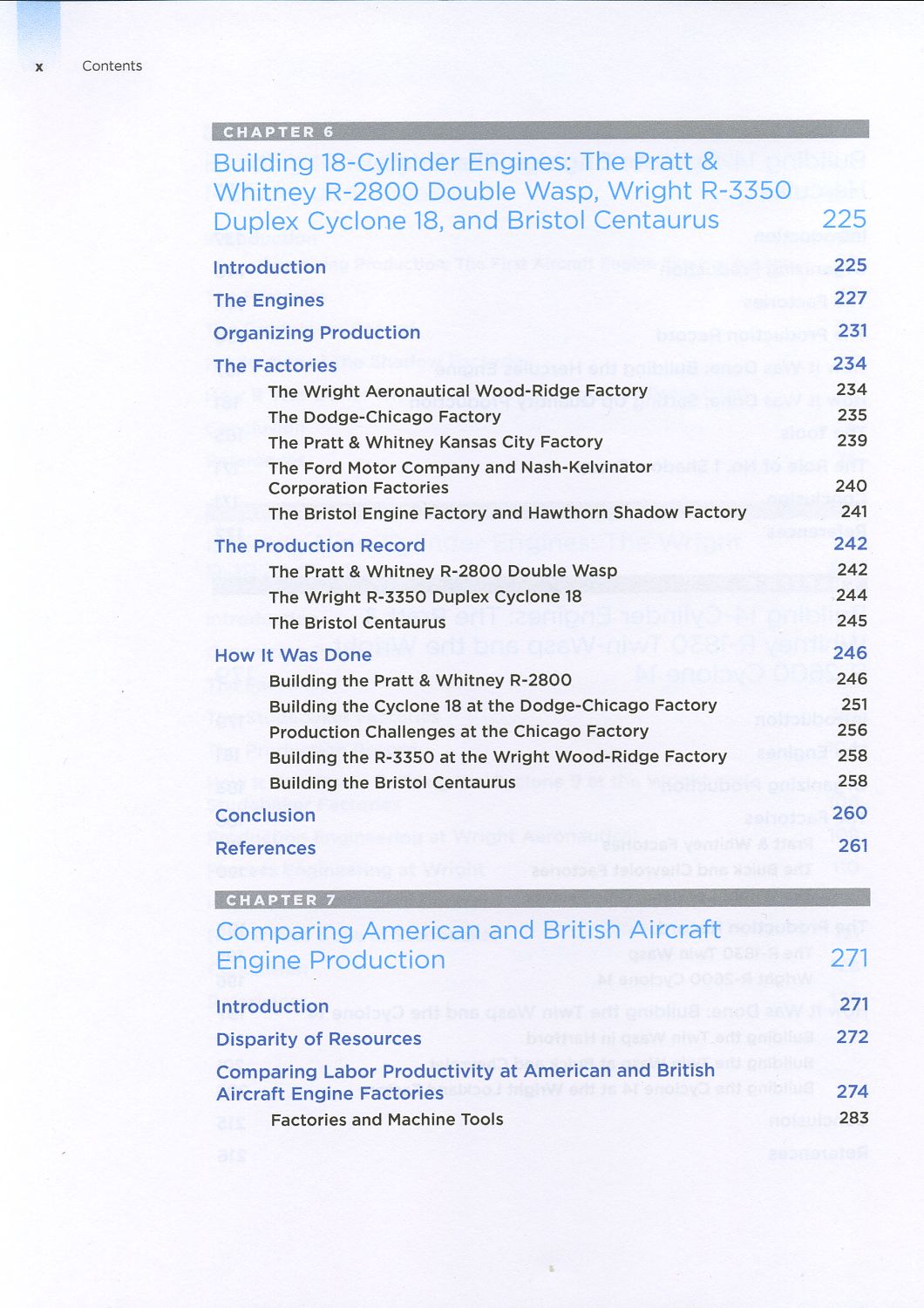
This is like no aircraft engine book I've ever seen. Whereas most aircraft engine books are about engine design, testing and use, this one is about how the factories that built the engines were made: their conceptualization, organization, production engineering, construction, equipment, quality control and personnel. Young compares WWII Bristol, Pratt & Whitney and Curtiss-Wright single-row, medium-power two-row and high-power two-row engine production. He has apparently read everything ever published about aircraft engine production and has synthesized a grand view. The research is simply staggering; I've seen bits of what he presents in short trade publication articles, but it appears here in a single impressive volume with thousands of notes.
Both Britain and the U.S. began gearing up aircraft engine production for the upcoming war around 1936. Before then, aircraft engines had been built in relatively small batches, largely by skilled machinists using standard machine tools fitted with jigs and fixtures to speed up repetitive processes. Prior to WWII, not enough aircraft engines were built to justify custom tooling and factory automation.
Britain came up with the idea of building "shadow factories" located away from the main factory; some were to build components, others complete engines. But even the new shadow factories could not be built in a way that supported continuous production — there was always a risk of being bombed and the new factories had to include blast shields to mitigate the damage done by an explosion. The British were also reluctant to invest in special-purpose automation to the extent it was used in America — they were afraid it would make model changes too difficult. However, many machine tools the British did acquire came from the U.S.
The U.S. was fortunate that it was unlikely to be bombed. This allowed the expansion of existing factories and new construction of absolutely HUGE factories filled with automatic machines on production lines that took in raw materials at one end and delivered complete, run-in engines out the other. The U.S., with its much larger automotive industry, also made heavy use of it to produce staggering numbers of engines. It also employed conveyor systems to move parts and materials, something the British could not do because of blast walls within their factories.
Nine-Cylinder Engines
Young compares Bristol Mercury and Pegasus engine production to the Wright R-1820. Bristol Aeroplane shadow factories included Austin Motors, Bristol Shadow No. 2, Daimler Morot, Rootes Securities, Rover Motor and Standard Motor. Bristol Aeroplane and Austin Motors turned out complete engines; the others built components.
In the U.S., the R-1820 was of course built by Wright in Paterson, New Jersey, but Studebaker built far more complete engines in its South Bend, using components fabricated in its Chicago and Fort Wayne plants.
Fourteen-Cylinder Engines
Young compares Bristol Hercules with Pratt & Whitney R-1830 and Wright R-2600 production. Bristol built the Daimler No. 2, Rootes No. 2, Rover No. 2, Standard No. 2 and Bristol No. 3 shadow factories, all of which produced 60,672 Hercules engines during WWII.
In the U.S., Pratt & Whitney expanded its own factory and also contracted with Buick and Chevrolet to build engines. Buick built a new plant in Melrose Park, Illinois while Chevrolet converted factory space in Buffalo, New York. Together these plants built 171,964 R-1830s during WWII.
Curtiss-Wright manufactured 84,887 R-2600s in its Paterson, New Jersey plant and a newly-built plant in Lockland, Ohio. Curtiss-Wright, which had always preferred to build in-house, struggled with meeting the promised production, especially at Lockland; they lacked the experienced production engineers and mid-level managers necessary to properly organize and manage the plant. Curtiss-Wright did employ a highly-automated production line, but seemed to never get enough training done and couldn't maintain worker morale.
Eighteen-Cylinder Engines
The Bristol Centaurus was manufactured by Bristol at Filton and the Bristol No. 4 Shadow factory at Accington. Since it reached production later in the War, its factories were more highly automated by American machine tools. For many reasons, Bristol Centaurus production was slow achieving quantity production. Although at 2,500 hp, it was more powerful than the Wright R-3350, only 2,967 Centaurus engines were built during WWII.
The Pratt & Whitney R-2800, which completed its Type Test 1939, was manufactured by a huge new Pratt & Whitney Kansas City, Missouri plant, along with Nash-Kelvinator, Chevrolet and Ford (Detroit Michigan). During WWII, built 114,067 R-2800s. Its 13,000-plus parts presented a challenge, but its builders produced 50 successful, even innovative, versions.
The Wright R-3350, despite its troublesome gestation, was finally marginally acceptable in for Boeing B-29 power in May 1944. Built at the new Wright Wood-Ridge, New Jersey and new, largest-ever, Dodge-Chicago factories, the R-3350 enjoyed the epitome of factory and production design, despite a whopping 48,500+ design changes to the engine and its production tooling. A total of 32,240 R-3350s were produced during the war.
 |
 |
 |
 |
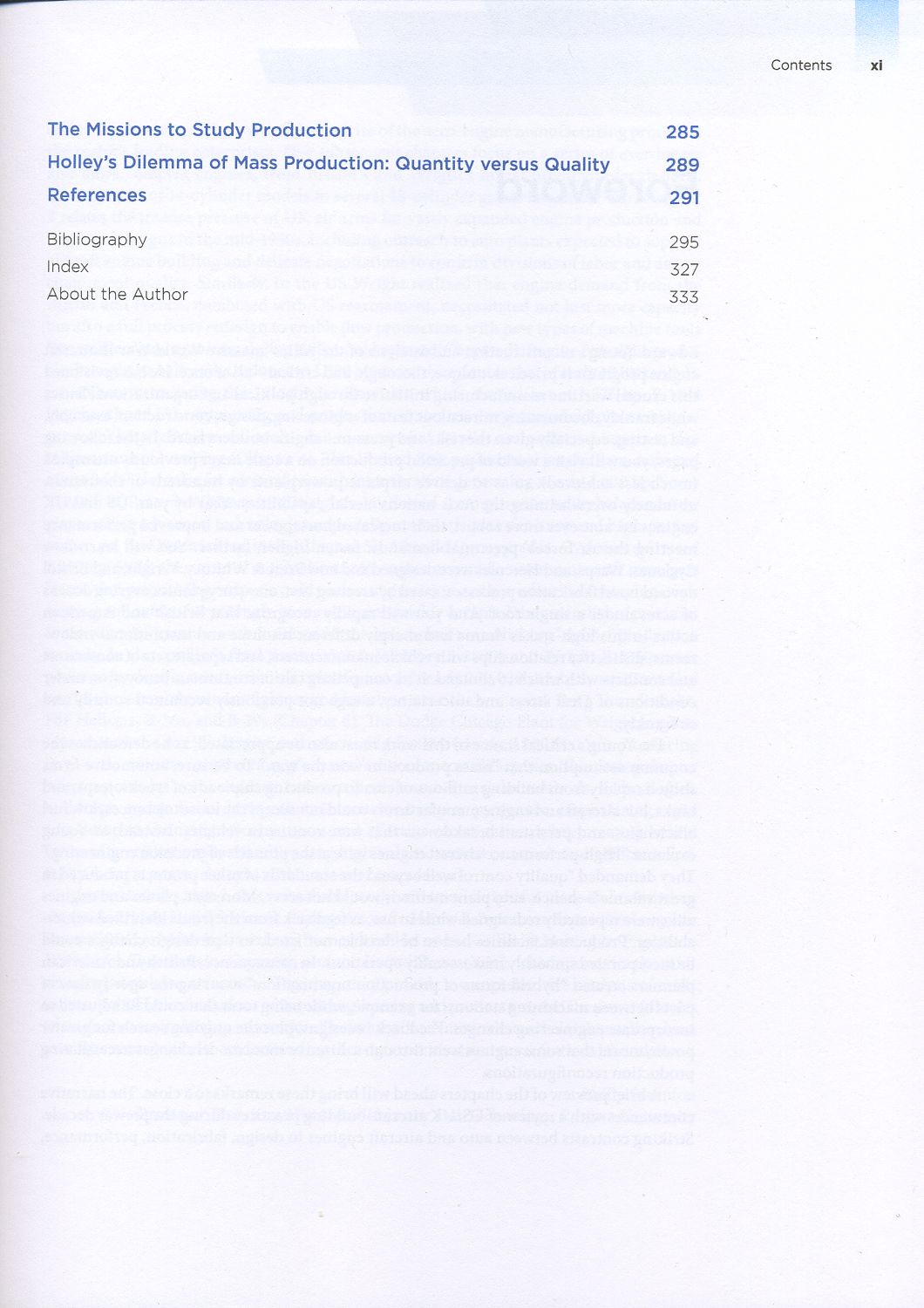 |
I cannot rave enough about how wonderful this book is. Not only has Edward Young created a masterpiece, but SAE, the publisher, has also done a superb job by presenting it in a quality hard-bound volume, with high-quality paper, three-color charts and decently-sized black and white images. This is a history book for the ages that belongs in every serious engine enthusiasts' library.
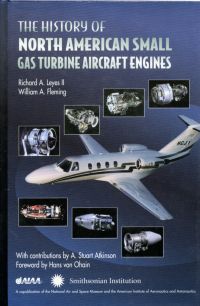 |
The History of North American Small Gas Turbine Aircraft Engines Hardbound, 9.25 x 6.5 x 2.25 inches, 998 pages Recommended Retail Price: $49.95 |
Reviewed by Kimble D. McCutcheon; 18 Jan 2024
This is a monumental book in almost every respect. As the title intimates, it covers the development of nearly all American small gas turbines up until the mid-1990s. Its authors have impeccable pedigrees: Leyes is a former National Air and Space Museum (NASM) Aero Propulsion Curator; Flemings had a storied career as a NACA and NASA researcher and leader; and Atkinson, with a long career at the Naval Air Systems Command, brings an insiders’ view of military propulsion development and acquisition. Often showcasing the vast NASM engine collection, this research/writing team explores how small gas turbine manufacturers and their technologies evolved in response to opportunities and market pressures.
The quantity and quality of research is impressive, as is the breadth and depth of coverage. It is on par with Development of Aircraft Engines and Development of Fuels by Robert Schlaifer and S.D. Heron (Harvard University, 1950). Chapter 1 explains the research and writing. Funded by the NASM, Leyes and Fleming followed a methodology intended to enforce thoroughness and accuracy. The authors apparently reviewed everything published about the small gas turbine industry and almost all the engines that entailed. They then approached the manufacturers with in-depth questionnaires and requests to interview key managers, engineers and sales personnel. This reviewer thinks the fruits of these interviews are especially important since many interviewees are no longer with us. The manufacturers, realizing that NASM and the authors were producing something of lasting importance, provided virtually universal access and assistance. Armed with mountains of data, the authors each wrote chapter drafts, which they exchanged for review. This process yielded a single chapter draft that was then reviewed by the manufacturer. A concise, complete and accurate portrayal emerged of how the marketing, engineering and development challenges were addressed as the industry and manufacturers evolved and grew.
Chapter 3 briefly describes initial wartime gas turbine development at Allis-Chalmers, General Electric, Lockheed, Northrop, Turbo Engineering Corporation and Westinghouse. Next, the post-war North American gas turbine pioneers including Westinghouse, Fredric Flader, Boeing and Fairchild are chronicled. Of these, only Fairchild, General Electric, and Westinghouse produced engines in quantity. Eventually all but General Electric abandoned the gas turbine business. These early companies served as training grounds for engineers and technicians whose names are later associated with successful gas turbine concerns.
Chapters 4 – 10 relate corporate histories of the major players: Allison, Garrett, General Electric, Lycoming, Pratt & Whitney Canada, Teledyne CAE and Williams International. Chapter 11 discusses the miniature and model gas turbines that arose to power small tactical missiles.
After having related the history of each major manufacturer, the book devotes Chapter 12 to trends, market forces, and technology that drove the whole industry’s evolution. Engine data tables, genealogy charts, acronyms and abbreviations largely comprise the three appendices, and the book concludes with acknowledgements and an index.
While The History of North American Small Gas Turbine Aircraft Engines is not highly technical, there is sufficient technical detail to illuminate the challenges overcome as the industry matured. There are also good discussions of the commercial and military customers, industry founders and leaders. In short, this is indeed THE history.
Almost everything about this book is a joy. Almost… If it has a flaw it is one for which I do not blame the authors, but instead lay at the feet of its publisher, the American Institute of Aeronautics and Astronautics (AIAA). The problem I have is with a format and layout that results in miniscule illustration sizes, which are a routine and glaring defect in AIAA publications that diminishes their technical value for present and future generations. One cannot properly illustrate a gas turbine cutaway or longitudinal cross section by orienting it as a portrait on a 6" x 9" page; the illustration is then only four inches wide! The AIAA technical history books will be read and referenced for the next 200 years, and every single reader will wish the illustrations were much better than they are. Two factors contribute to this: the book size and the inept layout. Why not print in 8.5" x 11" format and lay out long images, like gas turbine cutaways and line drawings, in landscape orientation? Finally, AIAA, stop constraining your authors with arbitrary page count limits; technical writing takes the number of pages necessary to properly tell the story. I know that publication and printing costs drive sale price, but most readers would willingly pay more money for books with usable illustrations. Are you listening, AIAA?
Despite the illustration limitations, this is a book that belongs in the library of every serious engine enthusiast.
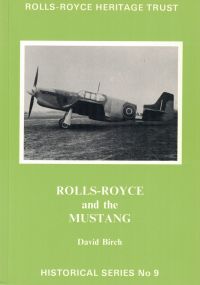 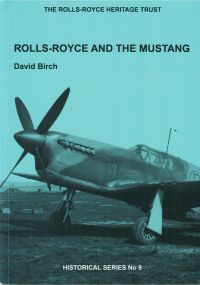 |
Rolls-Royce and the Mustang Softbound, 8.25 " x 5.75" x 0.5", 2nd Ed Recommended Retail Price: £18 1st Ed: 103 photographs/illustrations |
Reviewed by Tom Fey - 9 Jan 2024
Rolls-Royce Heritage Trust Historical Series No. 9
Rolls-Royce and the Mustang, written by AEHS member the late Dave Birch and published by the Rolls-Royce Heritage Trust, is an authoritative work chronicling the mating of the high-altitude Rolls-Royce Merlin engine to the superlative North American P-51 airframe. In retrospect this adaptation seems like a natural progression, but it was only following Rolls-Royce’s service liaison pilot Ronnie Harker’s first flight in the Allison-powered P-51, April 1942, that the efficiency of the airframe but deficiency in altitude performance was recognized and the conversion quickly proposed. It took a concerted effort by a multitude of interesting believers spread across two continents, multiple organizations, the air forces of the USA and Great Britain, starting two and half years after the start of WWII. It was not a simple, plug-and-play conversion. The two-stage V-1650 was wider and heavier than the Allison, an intercooling system had to be implemented, the carburetor intake needed to be turned 180°, airframe aerodynamics adapted to handle the increased horsepower, engine position modified to improve pilot sight lines, cooling systems adapted to dissipate 33% more heat, adjustment to the weight and balance, etc.
The P-51 was initially designed and built specifically for the British who get credit for the first service entry as well as the installation of the Merlin 61 into the heretofore Allison V-1710 powered P-51. The maiden flight of the Merlin conversion occurred on 13 October 1942 with the rapid generation of comparative flight performance data and continued conversion of additional aircraft. North American Aviation in Inglewood, CA trailed the British conversion to flight by six weeks, and throughout the process were shortages and delivery delays of both Packard and Rolls-Royce engines and components to equip test squadron aircraft. It is an interesting story expertly told and supported by original correspondence between the principal players, aircraft performance charts, excellent photographs, data tables, and specific documentation on the converted British aircraft. As a bonus there is a chapter on the Rolls-Royce Flying Test Bed (FTB), which was a proposed single-seat, single-engine (Merlin, Griffon, Crecy, Trent) test aircraft utilizing a Mustang wing and aft fuselage grafted onto a mid-engine center section driving shaft-driven tractor propeller(s) in the nose. A full mock-up and limited parts had been produced before the FTB project was cancelled on the last day of February, 1945.
Both a first (1987) and second edition (2018) of this book have been published, the latter with larger print, higher quality paper and photographic reproduction, some additional material, and a wonderful appendix containing a word-for-word telephone transcript between USAAC Col. Chidlaw and Brig. General Wolfe of Wright Field in June, 1942, trying to understand, plan, and agree on which Merlin to proceed with during the early days of the American conversion. I was a friend of Dave Birch and I have a biased and exceptionally high regard for his abilities as an aviation historian and author. That being said, and acknowledging the availability of other books on the topic, Rolls-Royce and the Mustang is by far the best work on the topic, especially for readers who enjoy thorough and technical detail.
 |
Wings of War: Hardbound, 6.3" x 9.3" x 1.2", 336 pages Recommended Retail Price: $29.00 |
Reviewed by Tom Fey – 21 Dec 2023; Revised 23 Dec 2023
Wings of War purports to tell the story of the North American P-51 Mustang from the design and development of the initial Allison-powered versions through the conspiracy/negligence of getting the Merlin-powered versions into service, and how the P-51 impacted the air war. I survived the 282 text pages, but it was a struggle. The book is a technical, factual, and chronological mess.
Unfortunately, the authors as well as editors Brent Howard and Grace Layer have sparing and diaphanous knowledge of aviation and aviation technology. Modernisms such as "... like a Jarvik-7 artificial heart ...", "... went viral..." and "... Craig Breedlove..." add nothing but confusion to the historical time frame. Technical detail is sparse, soft, and incomplete. Many players in the Mustang story, such as Lee Atwood, Ed Horkey and Irv Ashkenas, are left out. Breathless hyperbole is rampant. What exactly are "lizardlike Focke-Wulfs and stingray Messerschmitts? The authors state that automobile engines and aircraft engines are alike when they are two different engineering designs with very different requirements. The scheduled first flight date for what became the Mustang (October 26, 1940) was described as "D-Day" by the authors, 3.5 years before D-Day, the allied invasion of Europe (June 6, 1944), occurred! The terms spin, chord, stall, feather, loop, cannon, bogey, jug, rocket, jet, and bandit all have specific meanings in aviation, yet were used haphazardly and incorrectly throughout the book. The Me-163 was not “the first rocket powered plane ever to fly”. B-17's with a 17,600-pound bomb load? B-17’s flying from England to Berlin with a 9,000-pound bomb load? In describing the P-51D Shuttle missions, “They took almost the whole runway to get aloft, their heavy drop tanks weighed 108 pounds”. I can only assume they meant the 108 gallon paper drop tank which when loaded, weighed +/- 800 pounds each. The photograph chosen to depict the German Bf-109 is in fact a Spanish-built, post-WWII HA-1112 “Buchon” that, ironically, used the Merlin engine instead of the wartime Daimler-Benz. A single paragraph was devoted to P-51 operations in the Pacific theater. The book states P-51's were "... a superb warrior against the MiG-15's in Korea.” What? And as a final disappointment, the back cover graphics showing a front and side view of, I presume, a P-51D, appear to be the inaccurate renderings of a school boy.
In between, the authors accredit and draw heavily from previously published narratives dealing with the European air war, which were welcome. However, I found the descriptions of the life and times of Thomas Hitchcock and Donald Blakeslee to be the only content of merit.
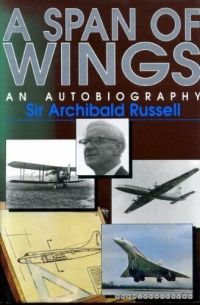 |
A Span of Wings 194 pages plus Appendices Out of Print but widely available used. |
Reviewed by Tom Fey 5 Nov 2023
Archibald Russell (1904-1995) was PhD aeronautic engineer whose career spanned the post-WWI era to the dawn of the Concorde. He joined Bristol in 1925 and retired from the amalgamated British Aerospace Company in 1969. In between his amazing career included stress analysis work on Bristol biplanes, stewardship of Bristol as chief designer, and carrying through the Brabazon, Brittania, Bristol Freighter, multiple Bristol studies and proposals on medium-range jet transport aircraft, and ultimately the Concorde. Russell is a gifted and directed writer who is unafraid to recognize and explain the successes and mistakes of his craft, company, and country. Among dozens of interesting stories and histories, he deftly reveals the early days of the Anglo-French Concorde project, weighing in on the shifting design goals, personalities, politics, economies, and choreography of the British, French, American, and Russians players of that time. It is a pleasure to read aeronautical history recorded by a person who experienced the projects in real time. I did not find a boring section in the whole book. Highly recommended.
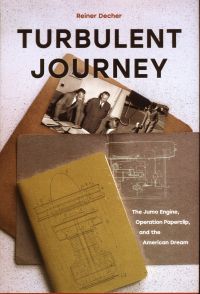 |
Turbulent Journey: The Jumo Engine, Operation Paperclip, and the American Dream Hardbound, 6.0" x 9.0" x 0.9", 192 pages Recommended Retail Price: $29.99 65 pictures/diagrams, black & white |
Reviewed by Kimble D. McCutcheon 21 Jan 2023
Turbulent Journey is a biography/autobiography about the German Decher family, Siegfried, Else, Reiner and Ulrich as they navigated WWII and its aftermath. Siegfried was an engineer who worked for Junkers in Dessau on the Jumo 004 jet engine, which powered the Messerschmidt Me 262. Siegfried designed the engine control system and received patents for some engine control elements.
Family life in wartime Germany was initially tranquil, but as the war progressed, the German army was driven from Russia and Allied bombers reached deeper into Germany, things became progressively more dire. When the war ended the Decher family decided to emigrate to America under Operation Paperclip, which swept up a about 1,600 German engineers and scientists. As invading Russians moved west, the U.S. Army began moving the family southwest just a week before the Russians arrived, but their truck was involved in an accident, which fractured Ulrich’s skull. Siegfried continued west while the rest of the family remained behind during Ulrich’s convalescence, hiding from the Russians. The family was reunited, but the Americans reneged on their offer of asylum.
Housing and food were scarce, but a reprieve came when Siegfried was offered a position at what was to become SNECMA (now Safran), resulting in a move to France. Ultimately, some of Siegfried’s Junkers colleagues who had made it to America arranged for him to work at the newly-formed AVCO gas turbine division. The Dechers finally made it to America in early 1954. Renier obtained a doctorate in aeronautical engineering and became professor emeritus at the University of Washington.
Turbulent Journey is a very personal account of a child growing up in and ultimately leaving wartime Germany. It relates many poignant stories about his family and their friends. Gas turbine technical issues are discussed only to the extent that they amplify the central personal theme.
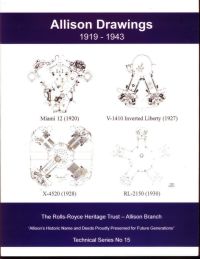 |
Allison Drawings: 1919 – 1943 Softbound, 8.5" x 11.0" x 0.75", 370 pages Recommended Retail Price: US $40.00 Lavish black and white illustrations |
Reviewed by Kimble D. McCutcheon - 20 Nov 2022
Rolls-Royce Heritage Trust Technical Series No. 15
John Leonard is a third-generation Allison engineer who is also the Rolls-Royce Heritage Trust – Allison Branch archivist and newsletter editor. His previous publications include The Allison Engine Catalog and Jim Allison's Machine Shop – the First Thirty Years.
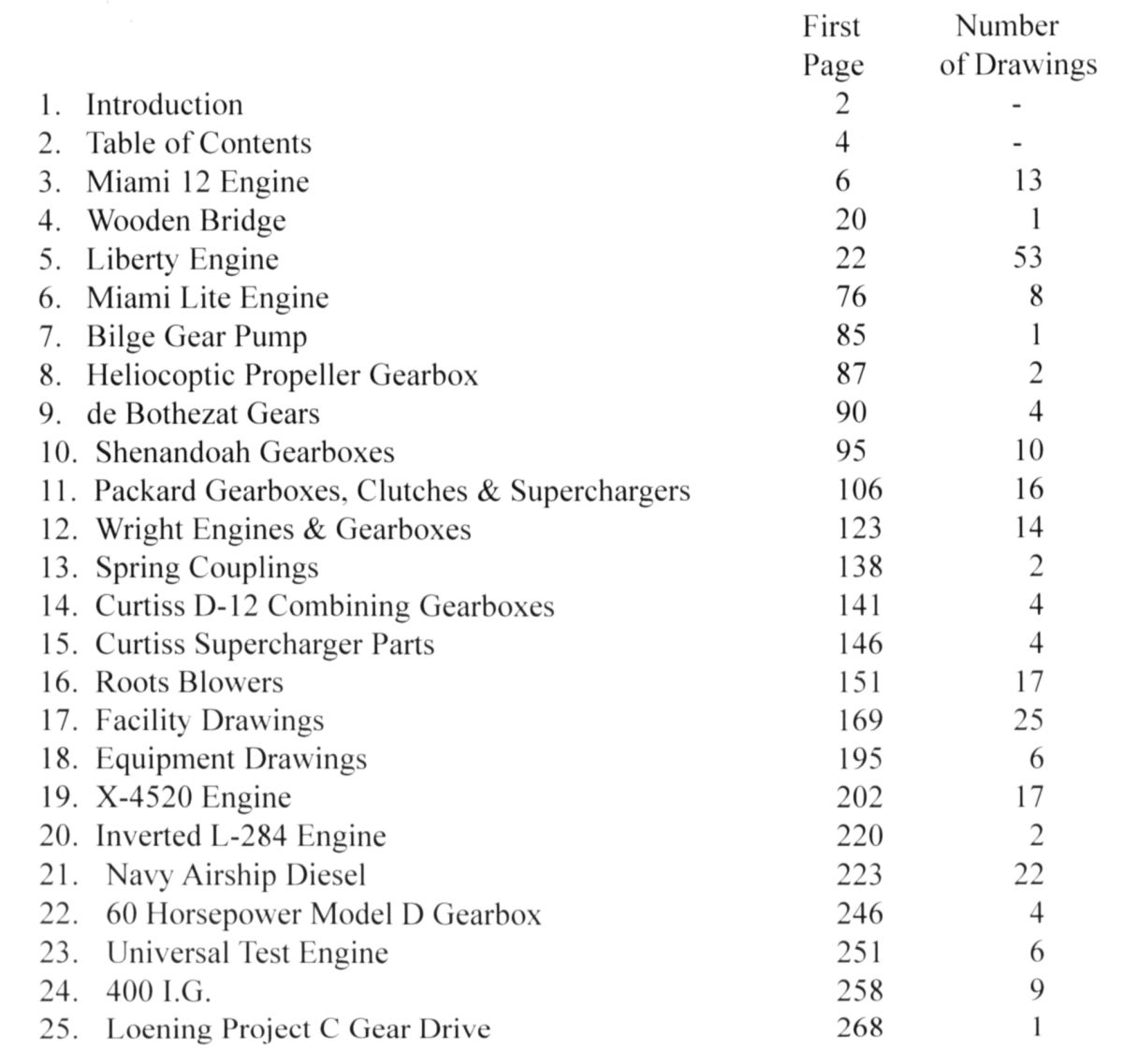
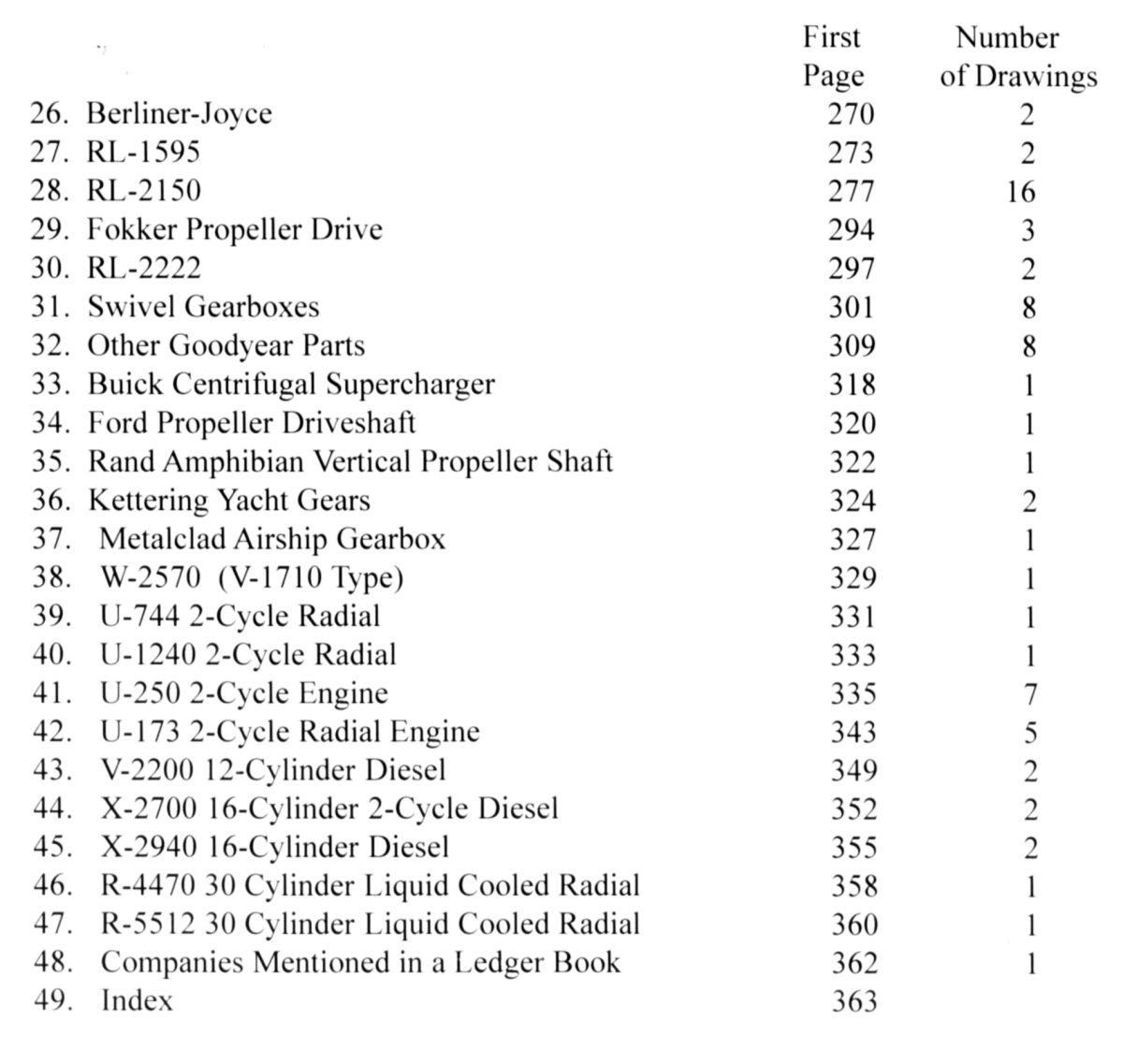
While processing the Allison Branch archival collection, John discovered a number of old microfilm rolls containing heretofore unpublished proposal concept drawings, including V-1710, V-3420 and V-6840 engines and installations. John spent countless hours making these drawings suitable for publication. Together with Daniel D. Whitney, Leonard co-wrote Allison V-1710 and V-3420 Designs and Concepts, which concentrates on the Allison V-1710 and its developments. Leonard's latest book, Allison Drawings: 1919 – 1943, presents a huge drawing archive that is not part of the V-1710 family. Allison began as a general purpose machine shop that soon garnered a reputation for innovation and quality. These included gearboxes and shafting for airships, propeller reduction gearing, and numerous engine concepts. Allison Drawings uses a landscape layout throughout, which makes the best use of its large 8.5" x 11.0" pages. For someone interested in mechanisms in general and in Allison history specifically, this book is a real treasure.
 |
 |
Rolls-Royce Heritage Trust Publications
| Many of the R-RHT books reviewed here can be purchased directly from the Trust. Please download the Book List/Order Form and follow the instructions therein. If you plan to buy more than one R-RHT title, you would probably save money by Joining the Trust. In addition to discounts on R-RHT publications, you would also twice-yearly receive The Journal of the Rolls-Royce Heritage Trust. |
Rolls-Royce Heritage Trust Historical Series
No 2. The Merlin in Perspective - the combat years
No 15. Olympus: the inside story
No 16. Rolls Royce Piston Aero Engines – a designer remembers
No 18. The Rolls-Royce Dart - pioneering turboprop
No 19. The Merlin 100 Series - the ultimate military development
No 21. The Rolls-Royce Crecy
No 26. Fedden
No 28. Boxkite to Jet
No 29. Rolls-Royce on The Front Lines - The life and times of a Service Engineer
No 30. The Rolls-Royce Tay Engine and the BAC One-Eleven
No 31. An Account of Partnership - Industry, Government and the Aero Engine
No 32. The Bombing of Rolls-Royce at Derby
No 34. Pistons to Blades
No 35. The Rolls-Royce Meteor
No 36. 50 Years with Rolls-Royce
No 39. Parkside: Armstrong Siddeley to Rolls-Royce 1939-1994
No 41. Overhaul of Merlin Engines in India and the USSR
No 43. Eagle: Henry Royce’s First Aero Engine
No 46. Rolls-Royce and the Halifax
No 47. The History of the Rolls-Royce RB211 Turbofan Engine
Hucknall – the Rolls-Royce Flight Test Establishment
Rolls-Royce Heritage Trust Technical and Special Series
No 1. Rolls-Royce and the Rateau Patents
No 2. The Vital Spark - the development of aero-engine sparking plugs
No 3. The Performance of a Supercharged Aero Engine
No 4. Flow Matching the Stages of Axial Compressors
No 5. Fast Jets - the history of reheat development at Derby
No 7. Rocket Development with Liquid Propellants
No 9. The Allison Engine Catalog - 1915-2007
No 10. The Rolls-Royce Spey
No 12. Jim Allison’s Machine Shop: The First 30 Years
No 13. V-1710 and V-3420 Designs and Concepts
Special: Sectioned drawings of Piston Aero Engines
Special: Alex Moulton: Bristol to Bradford-on-Avon---a lifetime in engineering
More Reviews
Advanced Engine Development at Pratt & Whitney
Jim Allison's Machine Shop
A Pictorial A to Z of Vintage and Classic Model Airplane Engines
America’s Round-Engine Airliners
Arsenal of Democracy
Beast - The Top Secret Ilmor-Penske Engine
Beautiful Engines: Treasures of the Internal Combustion Century
British Light Aeroplanes
By Precision Into Power: A Bicentennial Record of D. Napier & Son
The Canadair North Star
Classic Racing Engines
Curtiss-Wright
Dependable Engines
Deutsch Triebwerke
Douglas Light Aero Engines
Early Russian Jet Engines and Russian Piston Aero Engines
El motor de la aviación (De la "A" a la "Z")
The Electra Story
The Engines of Pratt & Whitney
Frank Whittle: Invention of the Jet
The Focke-Wulf Ta 152
German Jet Engine and Gas Turbine Development 1930-1945
Hans von Ohain
History of the Liberty Engine
Japanese Aero Engines
Jet: The Story of a Pioneer
The Knife and Fork Man: The Life and Work of Charles Benjamin Redrup
Luftwaffe Secret Projects
The Magic of a Name THE ROLLS-ROYCE STORY: The First 40 Years
The Magic of a Name THE ROLLS-ROYCE STORY Part Two: The Power Behind the Jets
Master Motor Builders
Me262 Volume One
Negative Gravity
Wolseley Radial Aero Engines: Lord Nuffield’s Thwarted Venture
Pioneer Mechanics in Aviation
Piston Aero Engines — 3D CAD Images & Animations
The Power for Flight
Power To Fly: An Engineer’s Life
Reinventing the Propeller
R-4360: Pratt & Whitney’s Major Miracle
Rotol: The History of an Airscrew Company
The Race for Hitler’s X-Planes
Rocketbelt Pilot’s Manual
The Romance of Engines
The Secret Horsepower Race
Seven Decades of Progress
Sonic Wind
Starting Something Big
Studebaker's XH-9350
Tank Aero Engines
Turbojet History and Development 1930-1960 Volumes 1 and 2
The V-12 Engine
Early Westinghouse Axial Turbojets
Westinghouse Aviation Gas Turbine Designs & Studies
Westinghouse J40 Axial Turbojet Family
Westinghouse J46 Axial Turbojet Family
The Wright Brothers, 1904 & 1905
Read a good one lately? Please write a review for this section!
Send mail to
 with questions or comments about this web site.